Friday, February 21, 2014

February plans for MGAM–“The People” Paper Pattern Service 581


odhamsPeople581-002


I’m running very late with this. There are good reasons: upgrading my work website clearlyedited.com and an editing, words and books blog at clearlyedited.wordpress.com. A shameless bit of link dropping – but I’m just so glad I’m nearly finished with only some minor (and probably endless) tweaking to go.

I’ve successfully avoided Wordpress until now, largely because I find their constant efforts to upsell  annoying. I appreciate that they need to make money, but really – $30 for a font or colour change?  I was getting so frustrated with the limitations of the free templates, I was nearly tempted. Nearly. I donated the $30 to a Mary River Turtle hatchling instead.

Back to “The People” 581. I obtained this from the UK. It’s undated but obviously from the 1950s. Inside, I found an old newspaper clipping advertising the pattern for ‘the spring bride’:

odhamsPeople581-002Ad

It’s not long until the end of February, so I’ll do the panties. Once I’ve finished, I’ll post a collection of notes and tips for choosing a vintage panties pattern, or drafting your own.

Friday, January 31, 2014

January’s dress–Simplicity 8829 (1970)

S8829

Not the pantdress though. I thought a sleeveless dress might be the ticket for a Queensland summer.

Thursday, November 14, 2013

Make a Garment a Month–My November Dress, Simplicity 2476 (late 1930s) in the planning


001

I’m very partial to #1. I can’t really see the puffs, cuffs and collar of #2 working for me, but if anyone out there has made this- I’d love to see it!

The mid- to late 1930s is my favourite period. The 1930s and this pattern in particular have their pluses and minuses for me.

Pluses:

Nifty pockets!

Relatively minimal redrafting needed for those of us whose hip measurement is a size or two  up from their bust measurement. For example this pattern is a size 16: bust 34 ins, waist 28, hip 37. By contrast the lower half of size 16 patterns from the same company shrank to 26 and 36 ins for waist and hip respectively.

Like many 1930s patterns, this is made up of a number of small pieces with good potential for using fabrics found in op shops, and recycled bits and pieces.

This particular pattern looks pretty straight forward:
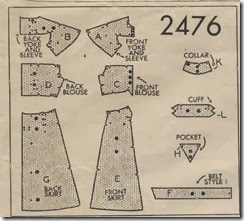
2476pieces

Minuses:

1930s styles, as depicted in pattern cover art, derive much  their aesthetically pleasing shape from exaggerated shoulder width and impossibly narrow hips. I always worry that the imagined style will not survive translation into an actual wearable garment.

This pattern is unprinted on fragile brown tissue. The pattern markings are made with holes. As you can see above, there are a lot of holes. Because the pattern is over 70 years old, there are a few more holes than there should be. I used my common sense as I traced it, but I’m not 100% sure I got them all in the right place.

As is usual for the 1930s, the instructions and accompanying diagrams are compressed and a little challenging. It turns out #1 has no seam or fastenings in the centre back of the skirt. Was it intended to be a housedress or an apron,or something in between?  #2 has a seam, but also an odd pleat that I can’t make sense of. This may be a clue that some of my guesses about the holes are wrong.

Here are my fabric swatches:

2476swatches

The bodice: soft Japanese printed cotton (picked up on sale at Spotlight).

The skirt: green polyester chiffon with a kind of scrunch dye effect to it  (op shop)

Skirt lining: blue poly-cotton (op shop)

Sadly, this fabric choice means I can’t do the pockets. I don’t think I can do those with chiffon. The points at the top of the skirt will give me enough pain as it is.

Wish me luck!

Sunday, November 10, 2013

The Secrets of Sewing: Sewing Efficiency


Containing Concise and Definite Instructions for the Better Use of the Sewing Machine

by Olive M. Elrich, Hazel L. Hunt ( 7th ed, Greist,  New Haven Connecticut 1925;  Bebarfalds, George St, Sydney)

From the back cover: ‘written so that a girl of 10 can understand it’, ’fully illustrated’

Price in 1925: 5 shillings (Australia)
Soft cover, stapled spine, 64 pages.

FrenchFold

‘The French Fold’ created with the binder and a pair of disembodied stunt hands.

Tuesday, October 29, 2013

Review: Commonsense Dresscutting and Drafting for Adults by Muriel May Staeheli

An Australian classic from the 1940s and 50s.

staehelicover

I absolutely love this book but it is a little hard to come by. I found it in Bayside Books, in Wynnum. Given there were so many editions, it must be around somewhere. If you’re in Australia, I recommend keeping an eye out for it in second-hand book shops. If that’s not an option, Abe Books and Ebay are obvious places to watch. Books & Collectibles is also a good place to look. Good luck! It is a great shame that this volume is not available as a modern reprint or an ebook. You will see at the bottom of this post that a small excerpt is available on scribd.

Successful Dressmaking by Ellen and Marietta Resek would make an ideal companion volume. It pops up regularly on the above websites. And I have tripped over it a couple of times in the back room at Bayside Books.

Wednesday, August 28, 2013

Long Bobbins for the Bebarfald Bluebird Sewing Machine


I have tried three types of bobbin in my Bluebird vibrating shuttle treadle machine: the original Bebarfald bobbin, a Singer bobbin, and a Frister & Rossmann bobbin.

LongBobbinsLengthView 

Wednesday, February 27, 2013

Dress Cutting by Margaret C. Ralston

Revisited! And a stash-busting update.

And what it is to be “wrong" in one’s fashion sense.

Wednesday, January 9, 2013

Bras, hypersensitive skin, summer and McCall 8092


McCall8092

Warning: this post contains no gorgeous embellishments, almost no lace and no pretty colours. It does contain a review of a vintage bra pattern McCall 8092. I did not make the bloomers because my fiancé begged me not to.

Wednesday, October 17, 2012

The Bebarfald Bluebird of Happiness: History and Mystery

bluebirdlogo

My Bebarfald Bluebird is an early twentieth century vibrating shuttle (VS) treadle sewing machine. It’s also Australian. Well, at least partly …

Wednesday, October 3, 2012

Butterick 6191 Blouse (1950s)


Vintage patterns wikia - Butterick 6191

Pros: raglan sleeves, nice and breezy for a humid summer and I hate setting in sleeves!
Cons: Will it look any good on someone whose waist is wider than their hand span? I don’t have a skirt to go with it and it definitely can’t be a massively full one as shown in the picture. Some people can rock the puffy skirts but I am not one of them.

Tuesday, October 2, 2012

Odhams Encyclopaedia of Needlecraft Illustrated (n.d., early 1950s, first edition): Review (part 2)

oldham3

Brian had been told this shirt dress would never date.  Looking back on it, he probably should have questioned why the dressmaker cackled wildly when she said this. Too late, he noticed the strange geometries of the fitting room. Surely they were non-Euclidean? A  creeping shadow made a slithering sound from behind the chair.

Tuesday, September 25, 2012

Odhams Encyclopaedia of Needlecraft Illustrated (n.d., early 1950s, first edition): Review (part 1)


oldham1

Yet another boring date with Captain Batrachian. If he wasn’t careful, she’d shove his trans-dimensional tentacles down his throats.

Intergalactic travel wasn’t all she’d hoped for.

Tuesday, September 11, 2012

Dress Cutting by the Block Pattern System by Margaret C. Ralston (1932): Review, part 3

After shortening Ralston’s Dress 2 into a tunic, I looked at the pleat on each shoulder and thought that this might go nicely with a cowl neck.

Thursday, August 23, 2012

Dress Cutting by the Block Pattern System by Margaret C. Ralston (1932): Review, part 1

First published in 1932, original editions of Dress Cutting are very rare. Fortunately it has since been edited and republished by Lacis Publications with the new title: Fashion Outlines. Dress Cutting has also been republished by Bramcost. This review is based on the Lacis edition.


Tuesday, August 21, 2012

Block pattern (sloper) drafting

A number of vintage sewing books include instructions on block (or sloper ) pattern drafting. Instructions are given on taking measurements from your body to draft a basic bodice, sleeve, skirt and occasionally trousers. You make up a prototype in calico (in Australia, NZ and the UK) or muslin (in the US). This prototype is called a “toile”. Having tried on the toile, you mark any changes necessary and modify the drafted pattern accordingly.